%20--%3e%3crect%20width='1024'%20height='1024'%20rx='224'%20fill='%2316181d'/%3e%3cpath%20d='M%20292.8%20731.2%20A%20310%20310%200%201%201%20731.2%20731.2'%20fill='none'%20stroke='%238a909b'%20stroke-width='92'%20stroke-linecap='round'/%3e%3cpolygon%20points='700.1,329.6%20539.8,540.7%20484.2,483.3'%20fill='%23388bfd'/%3e%3ccircle%20cx='512'%20cy='512'%20r='44'%20fill='%23f2f3f5'/%3e%3c/svg%3e) Token Gauge
Token Gauge
Antigravity usage in your menu bar — yes, the tool formerly called Gemini CLI
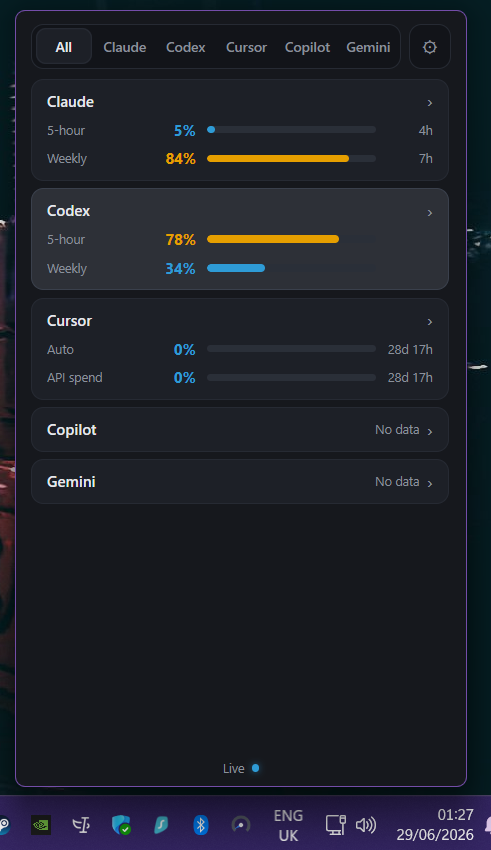
Searching for a "Gemini CLI usage tracker" still works — the tool just changed names. Google renamed Gemini CLI to Antigravity CLI for individual developers in June 2026, and most existing tools, docs and blog posts haven't caught up: the old name still gets typed into search bars, but the binary is now agy, not gemini. Token Gauge tracks both names as one agent. If you were already pointed at Gemini CLI, nothing about your setup needs to change — and if you're only now hearing "Antigravity" for the first time, it's the same tool, just relabeled.
Most write-ups and tools still cover the old name. Token Gauge tracks Antigravity alongside Claude Code, Codex, Cursor and Copilot in the same menu-bar popover — one place to check instead of hunting for whichever docs page hasn't gone stale.
Same tool, new name
Google retired Gemini CLI for individual accounts on 2026-06-18 — the old gemini command now returns a 403 — and Antigravity CLI (agy) is the direct successor. Token Gauge's log parser has read the legacy Gemini format since v1.0; support for the current Antigravity CLI log format is still in the works. As of v1.3.0 the agent is simply displayed as "Antigravity" everywhere in the app — the tab, the Overview, Settings, the tray tooltip and notifications — to match Google's naming. If you had Gemini connected before the rename, your existing history carries over under the new label; if you're on a fresh agy-only install, check that token counts look right and let us know if they don't.
What Token Gauge actually shows for Antigravity
Here's the honest version, not the optimistic one: Google's Antigravity CLI doesn't expose a usage percentage or quota endpoint the way Anthropic and OpenAI do for their own agents. So Token Gauge doesn't invent one. What you get is real token usage, read from legacy Gemini CLI logs, with Antigravity CLI (agy) log support still in the works — parsed locally, no server round-trip, no guessed number dressed up as a hard percentage. Google publishes no session window, weekly cap or reset time for Antigravity, so no percentage or countdown is invented for it; what you see is what actually happened, in tokens. If Google ships a usage or quota endpoint later, we'll wire it in and update this page to match — until then, token counts are the accurate answer, and every other agent's percentage stays exactly as accurate as its own provider's data.
Antigravity tracking is part of the $7.99 lifetime license alongside Codex, Cursor and Copilot, not the free tier. Claude Code metering is free on its own, no license key required; unlocking Antigravity (and the rest) is a single one-time purchase — three devices, Mac and Windows, no subscription, no recurring charge tied to how much Antigravity you use.
Local reads, honest scope
Token Gauge reads your Gemini CLI logs on your machine (with Antigravity CLI log support still in the works) — never your prompts, code or conversation content. Over the network it makes only three kinds of calls — each connected provider's own usage and sign-in endpoints, one Lemon Squeezy license check, and a check for app updates; it isn't fully offline, but nothing you write to Antigravity leaves your machine because of Token Gauge. It gives you visibility into what you've used — it doesn't raise your quota, unlock more calls, or change anything Google bills you.
Fidelity in plain terms: Antigravity gets token counts, not a percentage — that's a limit of what Google exposes, not something we're withholding. Every row in our fidelity table gets the same honesty: a true percentage where the provider exposes one, real counts or spend where it doesn't.
Antigravity questions, answered
Yes — it's the same tool. Google renamed Gemini CLI to Antigravity CLI (agy) for individual developers in June 2026, and since v1.3.0 the agent is simply labeled "Antigravity" throughout the app. Token Gauge has read legacy Gemini CLI logs since v1.0; support for the newer Antigravity CLI (agy) log format is still in the works, so fresh agy-only installs may not show usage yet.
Token counts, read locally from legacy Gemini CLI logs, with Antigravity CLI (agy) log support still in the works. Google doesn't expose a usage percentage or quota endpoint for Antigravity the way Anthropic and OpenAI do for their tools, so Token Gauge shows real counts instead of guessing at one — no invented percentage.
No. The free tier covers Claude Code only. Antigravity, along with Codex, Cursor and Copilot, is unlocked by the one-time $7.99 lifetime license — a single purchase covers Mac and Windows on up to three devices, no subscription.
Because Google doesn't publish one. Claude Code, Codex and Cursor show a true usage percentage because their providers expose that data; Copilot shows GitHub's own monthly-credits percentage. Antigravity's provider — Google — currently exposes usage only as raw log data, so that's what Token Gauge shows: real counts, honestly labeled, not a fabricated percent.