 Token Gauge
For developers who hit AI limits mid-task. If you never brush a limit, you don't need this.
Claude cut you off mid-task. Nothing warned you.
Token Gauge puts every agent's real limit in your menu bar or tray: Claude Code per model, Copilot's own percentage, Cursor and Codex, plus Antigravity token counts. Glance up, see the runway, finish the task.
30 days, one email to [email protected], full refund. No form, no argument.
Claude Code metering is free. No account, and your code never leaves your machine.
Public releases on GitHub: 6 MB on Mac, 4 MB on Windows, 9 MB on Fedora. Every number comes from the provider's own meter or your local logs. No telemetry.
On macOS, at 100% the menu bar switches to the reset countdown. Polling speeds up once any agent reaches 80%, and slows while every window is under 40%. Lifetime can alert at every 10%.
For Windows 10/11, macOS 12+ (Apple Silicon), or Fedora.
Works with Claude Pro, Max, Teams and Enterprise. Free claude.ai plans expose no usage data, so there is nothing to meter.
Why this exists
Token Gauge exists because Claude cut me off mid-refactor: context loaded, nearly done, and suddenly the only number on my screen was a reset time. The quota was always going to run out. What stung was that nothing warned me.
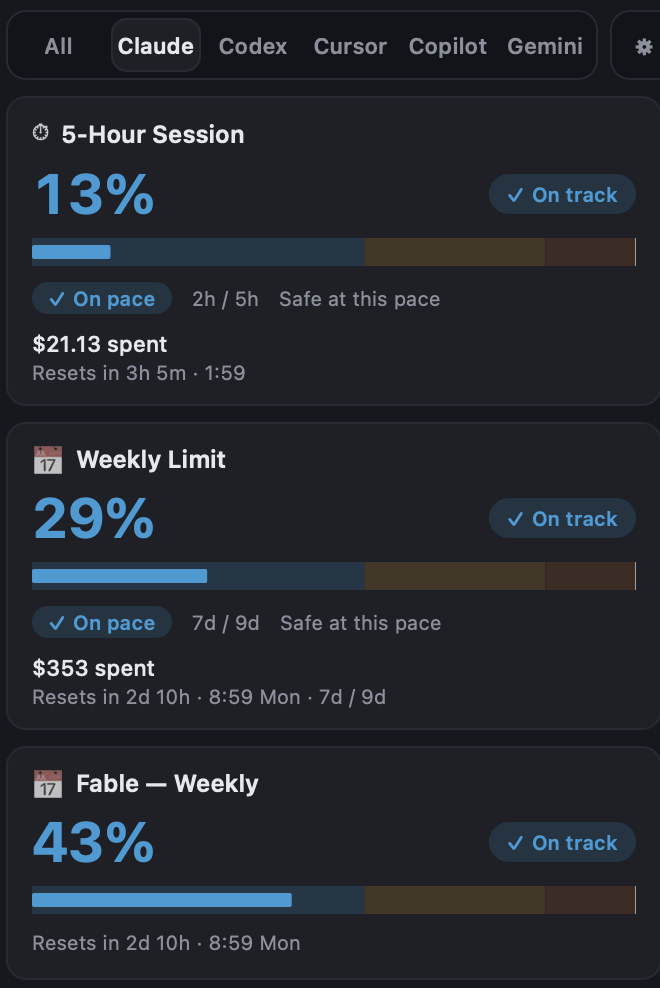
So now a number sits in my menu bar. It reads each provider's own usage signal and shows what's left and when it resets: the 5-hour window, the weekly cap, and each model's own weekly limit, like Fable's, which can run dry days before your overall week does.
If you have ever watched a nearly finished refactor die against a reset timer, you already know why this exists. I built it for that exact moment, mine and yours.
It's a meter. It won't raise a limit, and where a provider doesn't publish a number, it says so instead of inventing one. It reads usage on your machine; your code and prompts never leave it. No account. No telemetry. $11.99 once. If it isn't for you, email within 30 days and I refund you.
kierz.io, one person · [email protected] is my actual inbox
What it shows, exactly
Five agents. No invented numbers.
Five agents, three operating systems, one $11.99 licence: alerts before the wall, a reset alert after it, and quiet hours. Each agent is reported exactly as its provider counts it, and a percentage appears only where the provider publishes one.
| Agent | What you see | Tier |
|---|---|---|
| Claude Code | Overall 5-hour + weekly true %, reset countdowns and default alerts; Lifetime adds per-model limits, history and alert controls | Free + full meter |
| Codex | Live 5-hour and weekly usage % plus token counts | Lifetime |
| Cursor | Cursor's own included-usage % for the billing cycle, plus estimated spend; per-model request counts where Cursor still reports them | Lifetime |
| Copilot | GitHub's own monthly-credits %, the same meter VS Code shows, plus real per-model spend | Lifetime |
| Antigravity | Token counts from legacy Gemini CLI and Antigravity (agy) logs; agy support is not yet verified against a real install. Google exposes no usage % | Lifetime |
Weighing up other usage trackers? See how Token Gauge compares with CodexBar, OpenQuota, SessionWatcher and ccusage.
Free Claude alerts fire at 80% and 95%. Lifetime makes thresholds configurable and adds reset alerts and quiet hours wherever a true percentage exists. Free claude.ai plans have no usage endpoint. Pro, Max, Teams and Enterprise are supported.
$11.99 once. A typical dev-tool subscription passes that in its second month.
Most dev tools want $10 to $20 a month, every month. Token Gauge is $11.99, once, on Windows, macOS and Linux. Claude Code tracking stays free. Ten minutes lost to one surprise cutoff already cost you more.
Free
Claude Code metering
$0
- Overall 5-hour and weekly percentages with reset countdowns
- Default alerts at 80% and 95%, before the wall
- A reset countdown in the macOS menu bar at 100%, and faster checks near a limit
- No account: it works the minute it launches
- The whole download: 6 MB on Mac, 4 MB on Windows, 9 MB on Fedora
Not notarized on Mac and not code-signed on Windows yet: expect a one-time right-click Open on Mac, or SmartScreen's "More info, Run anyway" on Windows. The Fedora RPM is unsigned too. After that it just runs. Every release ships a SHA256SUMS.txt checksum file, so you can check your download matches the published release.
Lifetime
All five agents, every OS
$11.99 once
- 30-day money-back guarantee: email me and it's done
- Codex, Cursor and Copilot join Claude Code in one meter, with Antigravity token counts alongside
- Per-model Claude weekly limits, history, pace and deltas
- Custom alert thresholds, reset alerts and quiet hours
- Your primary agent's gauge lives in the menu bar or system tray
- Windows, macOS and Linux on one licence, 3 devices
- An optional alert at every 10%
- Every future agent and update included
30 days, one email to [email protected], full refund. No form, no argument.
The price is $11.99. That is the whole price, on up to 3 devices, on Windows, macOS and Linux. Checkout is handled by Lemon Squeezy, the merchant of record. Your key is emailed the moment checkout completes, and every build ships from GitHub.
Straight answers.
Yes: Apple Silicon (M-series) on macOS 12 or later. The app is ad-hoc signed but not notarized. On first launch, right-click the app → Open → Open. If macOS reports the app as “damaged”, run xattr -dr com.apple.quarantine /Applications/Token\ Gauge.app, then open again. On macOS Sequoia, use System Settings → Privacy & Security → Open Anyway. After the first successful launch, it opens normally from the menu bar.
Same app, same licence: one purchase covers Windows, macOS and Linux. On Windows, Token Gauge lives in the system tray. The published installer isn't code-signed yet, so SmartScreen warns on first run: choose More info → Run anyway.
Claude Code, Codex and Cursor show a true usage percentage. Free includes Claude's overall 5-hour and weekly percentages; Lifetime adds per-model Claude weekly limits, like a separate Fable bar, plus the other agents. Copilot shows GitHub's own monthly-credits percentage, read from the same meter VS Code's dashboard uses, plus real per-model spend; where that meter isn't available it falls back to real consumption with no invented percentage. Antigravity, Google's successor to Gemini CLI, shows token counts only. Antigravity CLI (agy) log support is in but not yet verified against a real install, so counts may be missing or wrong. The table above labels every row so you never mistake an estimate for a hard number.
No. Token Gauge is a meter: it shows your usage and reset timing so a limit never surprises you. It does not raise limits, add quota, or change what you pay your providers.
Because /usage only helps when you remember to type it, and the cutoff tends to arrive mid-task, when you are not checking. Token Gauge keeps the number in your menu bar or tray and, on the free tier, warns you at 80% and 95% before you hit the wall.
No. Token Gauge is local-first: it reads usage on your machine, and over the network it makes only three kinds of calls: each provider's own usage and sign-in endpoints, one Lemon Squeezy license check, and a check for app updates. Your code and prompts never leave the machine.
Only to find the login Claude Code already saved. It reads both the ~/.claude/.credentials.json file, if Claude Code wrote one, and the Claude Code-credentials entry in your system credential store (on macOS, through Apple's security command) on every refresh, and uses whichever token is fresher. It never writes to or changes that entry, and that token goes only to Anthropic's own usage endpoint. If you sign in through Token Gauge instead, it keeps its own token in a separate tokengauge-claude-oauth entry.
Yes. The public releases repo includes a Fedora x86_64 RPM, tokengauge-fedora-x86_64.rpm, built for Fedora 44 and newer. That published package is unsigned, opens as a normal window, and shows a tray icon when a StatusNotifier host is available. Install it with sudo dnf install --nogpgcheck ./tokengauge-fedora-x86_64.rpm (unsigned, so dnf needs --nogpgcheck). There is no in-app updater on Linux: install a newer RPM to update. There is no Ubuntu package. Details are on the Linux page.
Three devices on one $11.99 licence, lifetime updates included, no subscription. You buy it once and own it. The same licence covers Windows, macOS and Linux.
You may not need to. CodexBar and OpenQuota are free and MIT-licensed, and if you want to read the source, they are the right choice. The $11.99 buys these together: Windows, macOS and Linux on one licence, threshold and reset alerts with quiet hours, in-app updates on Mac and Windows, a person who answers [email protected], and a 30-day refund. It covers five agents, not dozens, and reads each one the way its provider counts it. The comparison page has the details.
Yes. Checkout runs through Lemon Squeezy, the merchant of record. The receipt email includes a link to generate a full invoice with your company's details. The individual license is $11.99 once for one developer on up to three devices.
The next wall is already counting down. See it coming.
Free Claude overall limits and default alerts. All five agents, on every OS, for $11.99 once.
30 days, one email to [email protected], full refund. No form, no argument.
Lost your license key? Recover it here.